Most growing companies don’t fail because of bad products.
They fail because their systems can’t keep up.
Sales closes deals in HubSpot.
Finance runs billing in NetSuite.
Operations manually reconcile data in between.
That gap is where growth slows down.
NetSuite and HubSpot integration exists to close that gap, permanently.
When CRM and ERP operate as one system, revenue moves faster, reporting becomes accurate, and teams stop working around their tools.
Why NetSuite and HubSpot Integration Is Critical for Modern Businesses
Today’s buyers move fast.
They expect:
- Instant onboarding
- Accurate billing
- Seamless renewals
- Consistent communication
Disconnected systems make that impossible.
Without a proper HubSpot NetSuite integration, companies struggle with:
- Inconsistent customer records
- Delayed invoicing
- Revenue leakage
- Broken reporting
- Internal finger-pointing
Integration removes these bottlenecks and aligns teams around shared data.
Why NetSuite and HubSpot Integration Matters More Than Ever
Modern businesses move fast.
But disconnected systems move slow.
Without proper integration, companies face:
- Duplicate customers across platforms
- Inaccurate revenue reporting
- Manual order creation
- Delayed invoicing
- Conflicting dashboards
A well-designed HubSpot NetSuite integration removes friction between sales, finance, and operations — allowing the business to scale without chaos.
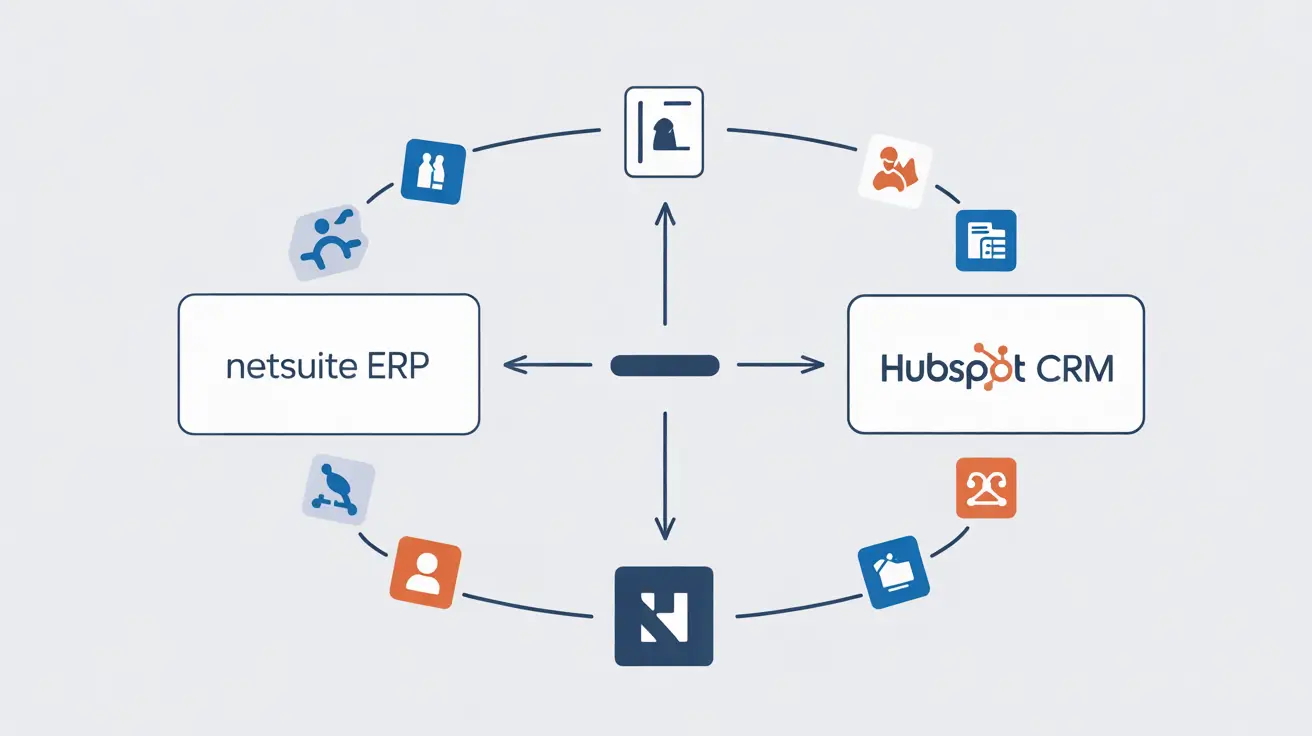
What NetSuite and HubSpot Integration Actually Does
This is not a “basic sync.”
True NetSuite and HubSpot integration aligns how your business works across departments.
Core Data That Gets Synced
- Companies & Customers
- Contacts
- Deals / Opportunities
- Products & SKUs
- Orders & Invoices
- Payments & Revenue status
Once integrated, each system does what it does best:
- HubSpot manages customer relationships and pipelines
- NetSuite controls billing, accounting, and fulfillment
No overlap. No confusion.
Core Data Objects in NetSuite and HubSpot Integration
A scalable integration typically includes:
- Companies / Customers
- Contacts
- Deals / Opportunities
- Products & SKUs
- Sales Orders
- Invoices
- Payments
- Subscription status
This creates continuity from lead → deal → customer → revenue.
7 Proven Benefits of NetSuite and HubSpot Integration
1. Sales-to-Finance Alignment
Closed deals in HubSpot automatically create customers, sales orders, or invoices in NetSuite.
No manual handoff.
No missed revenue.
2. Real-Time Revenue Visibility
Sales teams see invoice status directly inside HubSpot.
Finance teams trust CRM data.
Leadership sees one version of truth.
3. Faster Cash Flow
Automated invoicing reduces billing delays and improves collections.
Revenue recognition becomes predictable not reactive.

4. Scalable Growth Without Extra Headcount
Automation replaces repetitive tasks like:
- CSV imports
- Manual reconciliations
- Duplicate record cleanup
Systems scale so people don’t have to.
5. Cleaner Data Across Platforms
Clear ownership rules define where data originates and how it updates.
This prevents sync conflicts and long-term data corruption.
6. Better Customer Experience
Accurate data ensures:
- Correct billing
- Faster onboarding
- Fewer support issues
Happy customers stay longer.
7. Executive-Ready Reporting
Dashboards pull from clean, integrated data not assumptions.
Decisions improve when data is reliable.

Common HubSpot NetSuite Integration Scenarios
Sales-Driven Businesses
- Deal closes → invoice generated automatically
- Sales sees payment status inside HubSpot
Subscription Companies
- Contract start/end dates synced
- Renewals reflected across systems
eCommerce Brands
- Orders synced to NetSuite
- Customer data pushed back to HubSpot for lifecycle marketing
Common Mistakes in HubSpot NetSuite Integration
Many integrations fail not because of tools but because of shortcuts.
The Most Common Errors
- Syncing everything instead of what matters
- No defined source of truth
- Ignoring refunds, renewals, and edge cases
- No error handling or monitoring
- One-way syncs that break reporting
A rushed integration creates long-term problems.
Integration Architecture Options
A HubSpot NetSuite integration can be built using:
- Native connectors
- Middleware platforms (Zapier, Make)
- Custom API-based integrations
The right approach depends on:
- Data volume
- Business complexity
- Reporting needs
- Long-term scalability
Architecture decisions matter more than tools.
The UTECH HUB Approach to NetSuite and HubSpot Integration
At UTECH HUB, integration is treated as business architecture, not a technical task.
Our process includes:
- Business workflow mapping
- Source-of-truth definition
- Lifecycle-based data sync
- Exception handling (refunds, partial payments, renewals)
- Sync monitoring and error logging
- Reporting-first design
Because an integration that works today must still work at scale.
Who Should Implement NetSuite and HubSpot Integration?
This integration is ideal for:
- SaaS companies
- Subscription businesses
- eCommerce brands
- B2B service providers
- Agencies managing recurring revenue
If sales, finance, and operations touch different tools, integration is mandatory.
Final Thoughts: Integration Is a Revenue Strategy
NetSuite and HubSpot integration is not about syncing tools.
It’s about:
- Faster revenue
- Accurate reporting
- Operational clarity
- Scalable growth
Disconnected systems slow businesses down.
Integrated systems let them lead.
That’s what UTECH HUB builds.
FAQs
What is NetSuite and HubSpot integration?
NetSuite and HubSpot integration connects CRM and ERP platforms to automate customer, deal, order, and revenue workflows across sales and finance teams.
Is HubSpot NetSuite integration customizable?
Yes. A proper HubSpot NetSuite integration is tailored to business rules, revenue models, and reporting needs.
How long does NetSuite and HubSpot integration take?
Most implementations take 4–8 weeks, depending on complexity and data volume.
Does NetSuite and HubSpot integration improve reporting?
Yes. Integrated systems provide real-time, accurate reporting across CRM and ERP dashboards.
Who should implement NetSuite and HubSpot integration?
Any business using HubSpot for sales and NetSuite for finance will benefit — especially growing SaaS, eCommerce, and B2B companies.